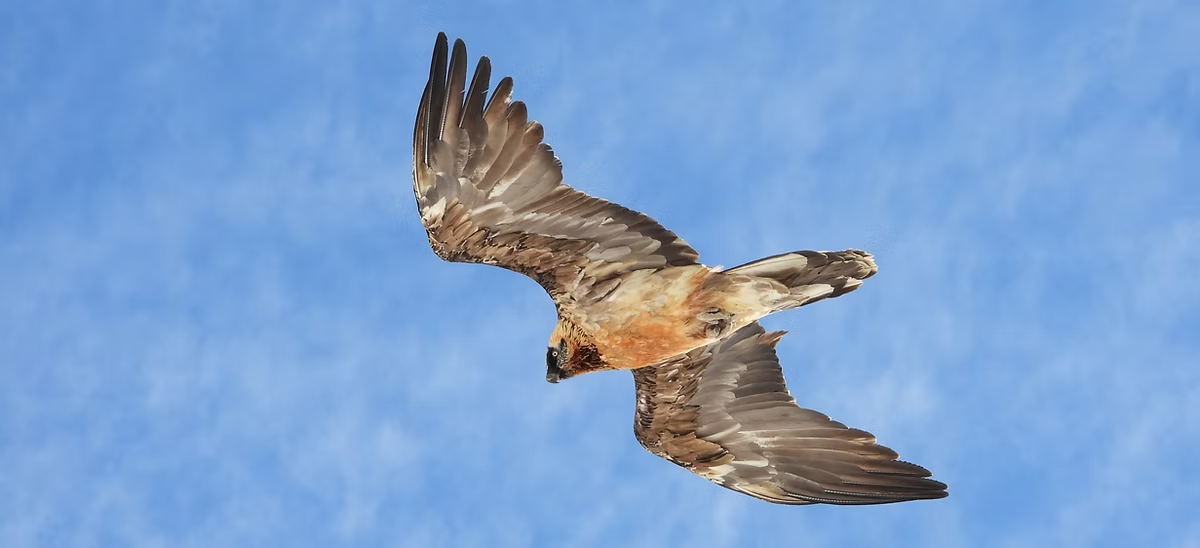
Ficedula Press Release, January 27, 2022
Let’s leave those bearded vultures alone
Someone tries to disturb them again
The bearded vulture’s second nesting attempt is in danger of falling through, just as it did last year. Yesterday, the repeated flight of a drone caused the brooding female to leave the nest—built in December (see below)—twice. The incident was observed and reported by those who have been monitoring the nesting for months.
Drones flying into rock faces always pose a serious threat to the ongoing nesting of sensitive or endangered species—or, as in this case, to a nesting attempt made 151 years after the last such nesting in Ticino: that of one of the Ticino pairs of bearded vultures.
Golden eagles, peregrine falcons, kestrels, eagle owls, and other species may, if disturbed, abandon their nests permanently. The danger is much greater when there are eggs—or even just one egg.
Ficedula does not want to criminalize the use of drones, but rather to draw the attention of the public—and especially drone users—to the following: Stay away from rock faces!
This type of disturbance is a crime and is subject to criminal prosecution. LCP Art. 17 b.
The Ticino Bearded Vultures Give It Another Try (2021/2022)
Over the past few months, a pair of bearded vultures has been very busy building their nest. They have lined it with soft, warm wool.
Nesting is underway and under control. If all goes well, the fledging is expected to take place in late July.
Gipeto Day 2021!
For the fifth time—or the sixth, if you count the first trial year—Ficedula is organizing a coordinated count of bearded vultures throughout the Sopraceneri region, in collaboration with the Gipeto Foundation (ZH) and IBM, the International Bearded Vulture Monitoring Network. This event, scheduled for October 2, 2021, coincides with the Alpine Bearded Vulture Observation Day and Eurobirdwatch, international bird-watching events held during the peak of fall migration.
The coordinated monitoring of the bearded vulture in the Alps involves hundreds of ornithologists and birdwatchers each year. In Ticino, we would like to document the species’ progression and colonization of the region over time. In fact, there are several subadults and adults that are gradually establishing themselves within the canton.
This year, we’ll once again be observing the two large Alpine birds of prey—including the golden eagle in Ticino—following last year’s torrential rains on October 3, 2020, when only a few intrepid participants took part.
Observations in 2021 are particularly important for counting eagles—especially young ones—to understand how much the summer of record-breaking rainfall affected the breeding success and survival of adults!
We are currently putting together a program and setting up a network of observation points. I invite anyone who is able or interested in participating to register by September 19 by writing to segreteria.ficedula@gmail.com.
During the fourth week of September, there will be a review session on identification criteria—specifically regarding age—for participants in the census. This session will take place via Zoom. Details will be sent to registered participants.
Thank you for your cooperation!
Welcome back, Gipeto!
After more than 150 years of absence, the largest vulture in the Alps is returning to nest in the Canton of Ticino!
Ficedula Press Release dated April 30, 2021
Ficedula, the Association for the Study and Conservation of Birds in Italian-speaking Switzerland, reports that the nesting of the first stable pair of Ticino bearded vultures—discovered in early December—is continuing. For the first time in history, the nesting of this large vulture in our mountains has thus been confirmed. The chick hatched a few weeks ago and is growing up under the attentive care of the two adults. However, there is still a long way to go before it takes flight; if all goes well, the chick will take its first flight in early summer.
Ficedula Press Release, December 4, 2020
Ficedula, the Association for the Study and Conservation of Birds in Italian-speaking Switzerland, reports that the bearded vulture—the largest vulture in the Alps, with a wingspan of three meters—has returned to nest in Ticino after more than 150 years.
Due to prolonged persecution, the Bearded Vulture had completely disappeared from the Alps. In Ticino, the last individual—a young female—was caught in a leghold trap and killed in 1869. Thanks to a major reintroduction project launched in the 1980s, this magnificent vulture began nesting in the Alps again about twenty years ago.
Since 2017, Ficedula has been coordinating the annual Alpine Accentor census in Ticino, which is conducted simultaneously throughout the Alps in October, in collaboration with the Pro Gipeto Foundation. Over the past few years, more than 100 volunteers, spread throughout the Sopraceneri region, have participated in this effort. As anticipated, thanks to the team’s efforts, the first nest on Ticino soil was finally discovered in early October! The bearded vulture pair has completed construction of the nest, which is located in an inaccessible spot, sheltered from the snow. The interior of the nest is completely lined with sheep’s wool; in fact, the bearded vulture was also known as the “lamb vulture” precisely because of its habit of using the wool from dead sheep to line its nest. In reality, the bearded vulture is not a predator but feeds exclusively on bones; farmers have nothing to fear! Egg-laying often occurs around the time of the first major snowfall. Let’s hope, then, that the heavy snow currently falling in Ticino brings good luck to Ticino’s first stable pair of bearded vultures.
Now we just have to wait patiently, and if all goes well, the “little” Gipeto will take flight in late spring 2021.
Ficedula thanks everyone who is participating in the Bearded Vulture censuses and invites all citizens to submit winter sightings via email to segreteria.ficedula@gmail.com or to contact the Association at 079 207 14 07; website: www.ficedula.ch.
For confidentiality reasons, no further information will be provided.
2020 Event Report
Ficedula, in collaboration with OTR Bellinzonese and Alto Ticino, has organized a network of bearded vulture observation points in Ticino.
Throughout the day, people counted bearded vultures, golden eagles, and other birds of prey. At least one Ficedula ornithologist was present at each observation point.
Last week, a free two-hour evening course was held to teach participants how to distinguish between eagles and bearded vultures based on their age-related plumage through a communication portal.
How to Tell the Difference Between a Golden Eagle and a Bearded Vulture in Flight (PDF)
Appeal in *Alpinista Ticinese*, September 2017 (PDF)
2019 Event Report
That day in 2019 was a true record-breaker for sightings of bearded vultures and golden eagles. Thanks to the more than 60 participants spread throughout the Sopraceneri region, we had at least eight different sightings of bearded vultures and over 40 of golden eagles!
A heartfelt thank you to everyone who participated!