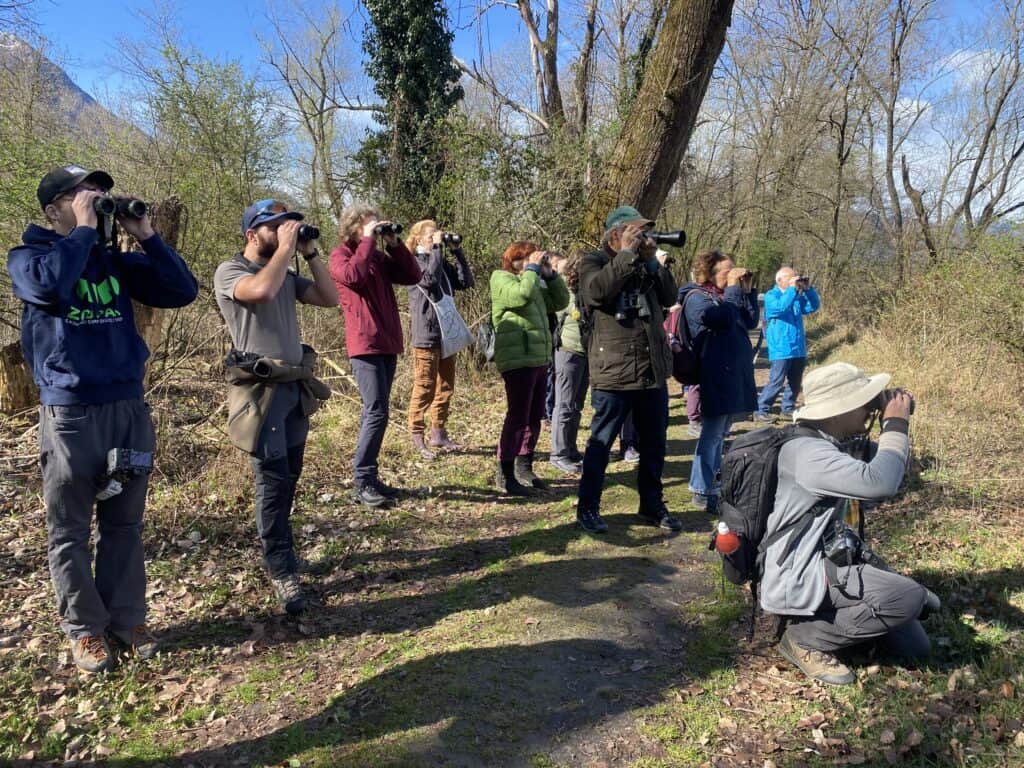
Ten Commandments for the Good Birdwatcher
1. When we’re out in the field observing, studying, and photographing, the birds’ safety must always be our top priority.
2. Observations should be made from a safe distance so as not to disturb the birds and to allow other interested people to observe them as well.
Birds’ lives are already complicated enough without adding new challenges—especially to satisfy the passions of birdwatchers and nature photographers. Please do not use recorded bird calls!
3. Do not approach the nests.
Many species, such as birds of prey, become alarmed even when the observer is MANY hundreds of meters away from the nest. In such cases, it is advisable to use a spotting scope or digiscoping.
4. Our presence in the environment must be unobtrusive.
Behaviors that disturb or alarm birds (loud voices, cell phone ringtones, etc.) should therefore be avoided. When leaving an observation hut, be sure to close the window shutters, even if you found them open.
5. Stay on the trails; do not trample or damage the vegetation.
Do not leave any traces that might attract predators. The recommendations and prohibitions issued by the relevant authorities (for example, the protection of species that nest on riverbanks) must be followed.
6. Respect private property.
This principle generally applies even when there are no fences. Do not enter hayfields or cultivated fields. It is important that farmers—whose cooperation is vital to nature conservation—have a positive view of us as birdwatchers.
7. Actively participate in data collection.
Reports made available to the scientific and conservation communities can enrich the area where we live.
8. Avoid disclosing the locations of breeding sites for rare and endangered species.
This is a matter of the utmost importance. A single photograph or observation is not worth the loss of a brood! Many sites are already under pressure, and the growing number of enthusiasts could soon have very negative consequences.
9. The proper conduct of observers, researchers, professionals, and photographers should serve as an educational example for those who are unfamiliar with the rules.
Nature can and must become a value even for those who do not consider or appreciate it. Curiosity could be the key to sparking a desire for knowledge.
10. Get involved in bird conservation and nature conservation in general, for example by joining a local nature conservation organization such as Ficedula or BirdLife Switzerland.
We need it. Simply chasing after images and rarity does not help conservation.